
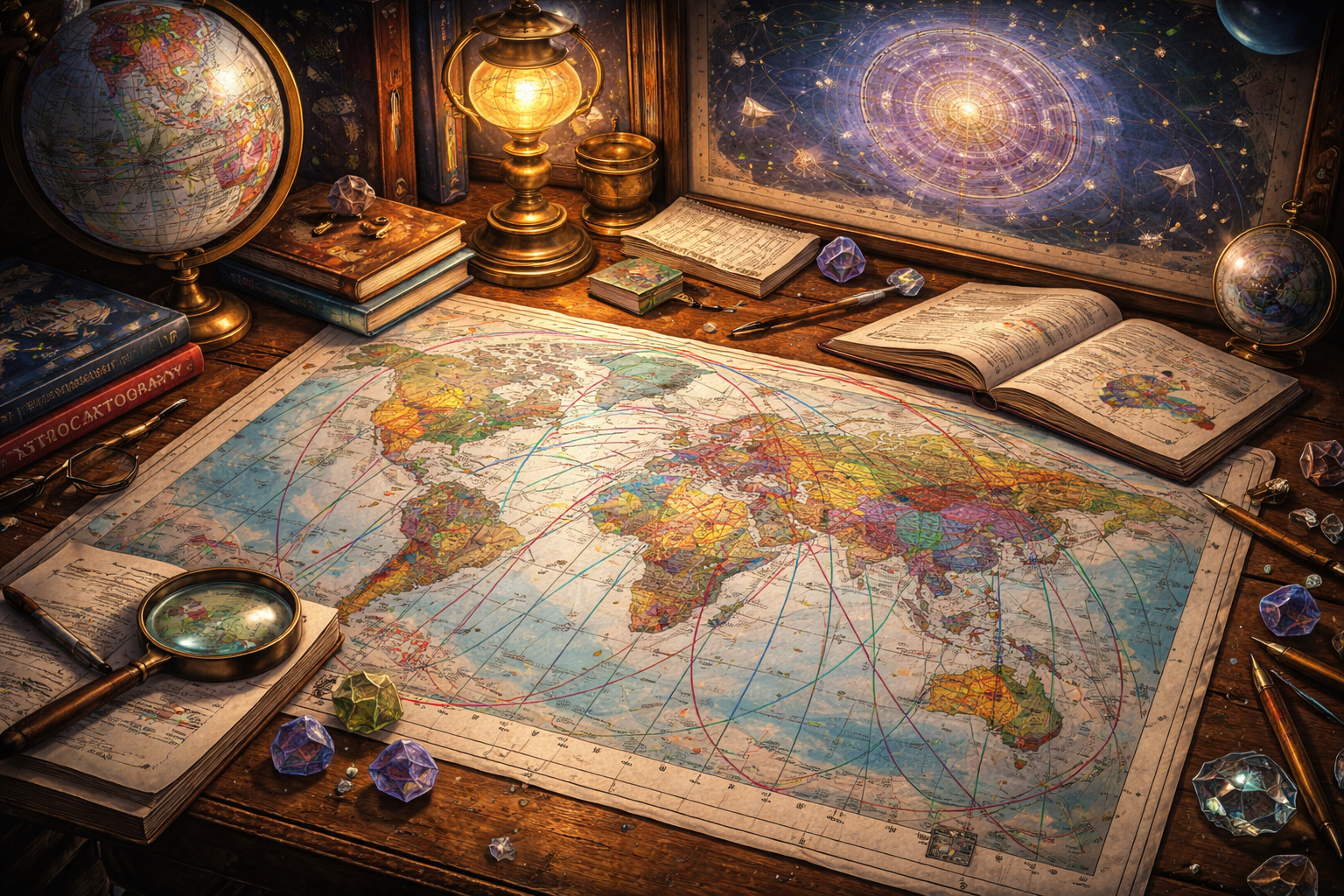
Astrocartography is a fascinating branch of astrology that blends celestial symbolism with geography. It answers a question many people have asked at some point in their lives: Why do I feel drawn to certain places, and why do some locations seem to bring out different sides of me? Astrocartography suggests that the answers may lie in your birth chart—and the way its planetary energies are distributed across the Earth.
Developed and popularized by astrologer Jim Lewis in the 1970s, astrocartography is the practice of mapping the positions of the planets at the moment of your birth onto a world map. These planetary lines are believed to influence your experiences in different locations, highlighting places where you might thrive, struggle, grow, or find love.
Understanding astrocartography can help you choose where to live, work, travel, or even retire. It offers a symbolic “energetic map” of the world tailored specifically to you.
The Basics of Astrocartography
At the moment you were born, each planet occupied a specific position in the sky relative to the Earth. In a traditional natal chart, those positions are interpreted in terms of houses, signs, and aspects.
Astrocartography takes this information and projects it onto a map of the Earth. It identifies where each planet was rising, setting, at the Midheaven (highest point in the sky), or at the Imum Coeli (lowest point beneath the Earth) at the time of your birth.
These four angles are considered highly potent in astrology:
- Ascendant (Rising): Identity, beginnings, and how you present yourself
- Descendant (Setting): Relationships and partnerships
- Midheaven (MC): Career, public life, and reputation
- Imum Coeli (IC): Home, roots, and emotional foundations
When a planet aligns with one of these angles in a specific location, it creates a “line” on your astrocartography map. Living or traveling near these lines is believed to activate the energy of that planet in your life.
How Astrocartography Maps Work
Your astrocartography map shows a series of vertical and curved lines crossing the globe. Each line represents a planet and an angle. For example:
- A Sun-Midheaven line indicates places where your identity and life purpose may be recognized publicly.
- A Venus-Ascendant line suggests locations where you may appear more attractive, sociable, and charming.
- A Saturn-IC line could point to places that feel heavy or serious, but also offer deep personal growth.
Generally, the influence of a line is strongest directly on it, but its effects can extend approximately 200–300 miles (300–500 km) on either side.
The Meaning of Each Planetary Line
Each planet carries its own symbolism. When you live or travel near a planetary line, you are said to experience the themes of that planet more strongly.
Sun Lines
Sun lines are associated with vitality, confidence, and recognition. These locations often feel natural and energizing. You may feel more like your true self, gain visibility, or find opportunities for leadership.
Best for: Career growth, self-expression, and personal empowerment.
Moon Lines
Moon lines heighten emotions, intuition, and sensitivity. These places often feel like home, even if you’ve never been there before. Family matters and emotional connections become more significant.
Best for: Settling down, nurturing relationships, and inner healing.
Mercury Lines
Mercury lines stimulate the mind. These are places where communication, learning, writing, and networking flourish. Life may feel faster-paced and intellectually engaging.
Best for: Education, media, writing, business, and travel.
Venus Lines
Venus lines are among the most popular in astrocartography. They bring beauty, harmony, love, and pleasure. People often meet romantic partners or develop artistic talents in these locations.
Best for: Romance, social life, art, and financial comfort.
Mars Lines
Mars lines are full of energy, drive, and assertiveness. These places can inspire action, ambition, and physical activity. However, they may also bring conflict or stress if the energy isn’t handled constructively.
Best for: Entrepreneurship, athletics, and pursuing goals with passion.
Jupiter Lines
Jupiter is the planet of luck, growth, and expansion. Locations along Jupiter lines often bring opportunity, optimism, and success. Many people experience prosperity or personal development here.
Best for: Career advancement, education, spiritual growth, and travel.
Saturn Lines
Saturn represents structure, responsibility, and discipline. Living near a Saturn line can feel serious or demanding, but it often leads to long-term stability and maturity.
Best for: Building a career, developing discipline, and achieving lasting success.
Uranus Lines
Uranus is the planet of change, innovation, and freedom. These places often bring unexpected events, new ideas, and unconventional experiences.
Best for: Reinvention, technology, creative breakthroughs, and independence.
Neptune Lines
Neptune governs dreams, spirituality, and imagination. Locations along Neptune lines can feel mystical or romantic, but they may also bring confusion or illusion if boundaries are unclear.
Best for: Spiritual retreats, artistic inspiration, and compassionate work.
Pluto Lines
Pluto is associated with transformation, power, and deep psychological change. Living near a Pluto line can be intense, but it often leads to profound personal evolution.
Best for: Deep healing, research, transformation, and empowerment.
How to Use Astrocartography in Real Life
Astrocartography is often used when people are considering major life changes, such as:
- Moving to a new city or country
- Choosing where to attend school
- Deciding on a vacation destination
- Relocating for work
- Planning retirement
For example, someone seeking romance might consider spending time near a Venus line, while someone focused on career success might look toward a Sun or Jupiter line.
It’s also possible to experience a place through “remote activation.” This concept suggests that you can connect with a location’s energy even without physically moving there. For instance, working with people from a certain region, decorating your home with items from that place, or frequently traveling there can activate its planetary influence.
Crossing Lines and Parans
Not all locations are influenced by a single planetary line. Sometimes two or more lines intersect, creating what astrologers call crossings or parans. These areas combine the energies of multiple planets.
For example:
- Venus + Jupiter: A highly fortunate combination for love and abundance.
- Mars + Saturn: Hard work, discipline, and potential conflict.
- Sun + Uranus: A place of sudden breakthroughs and personal reinvention.
These intersections can be especially powerful and are often considered key locations in a person’s life story.
Relocation Charts
In addition to astrocartography maps, astrologers often use relocation charts. A relocation chart recalculates your birth chart as if you were born in a different location.
This doesn’t change your planets or aspects, but it shifts the house placements and angles. As a result, different areas of life may become more prominent.
For example:
- A planet in the 12th house in your natal chart might move into the 10th house in a relocation chart, bringing hidden talents into public view.
- A quiet, introspective person might become more socially active in a location where their Sun moves into the 7th house.
Relocation charts provide deeper insight into how a place might affect your daily life.
The Role of Free Will
While astrocartography offers fascinating insights, it’s important to remember that it doesn’t dictate your fate. It highlights potentials, not certainties.
Two people living on the same planetary line may have very different experiences, depending on:
- Their overall birth chart
- Their personal choices
- Their mindset and life circumstances
A Saturn line, for example, may feel restrictive to one person but empowering to another who is ready to build something meaningful.
Astrocartography works best as a tool for awareness rather than a rigid set of rules.
Common Misconceptions
“Only good planets matter.”
Even challenging lines like Saturn or Pluto can bring valuable growth. Many people achieve their greatest accomplishments under these influences.
“You must move to a line to feel its effects.”
Traveling, doing business, or forming relationships in a location can also activate its energy.
“One line determines everything.”
Your entire chart and the type of line (Ascendant, Descendant, MC, or IC) all play important roles.
Why Astrocartography Remains Popular
In a world where remote work, travel, and relocation are more common than ever, astrocartography offers a symbolic guide to finding places that resonate with your personal energy.
Many people report that their experiences in different cities match the themes of their planetary lines. A person might feel socially vibrant on a Venus line, career-focused on a Sun line, or introspective on a Neptune line.
Whether taken as spiritual guidance, psychological insight, or simply a fun exploratory tool, astrocartography encourages a deeper relationship between the individual and the world.
Final Thoughts
Astrocartography is a unique blend of astrology and geography that invites you to see the Earth as a canvas for your personal journey. It suggests that certain places may amplify specific aspects of your personality, opportunities, and experiences.
By understanding your planetary lines, you can make more intentional choices about where you live, work, travel, and grow. While it doesn’t replace practical considerations like finances or job prospects, it adds a symbolic layer of meaning to your decisions.
In the end, astrocartography is less about predicting your destiny and more about exploring it—one location at a time.
Leave a Reply